 Faith & Worship
 If
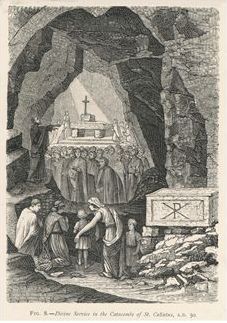
we look at two early accounts of the Church at worship we can begin to
get a feel for the foundations of our own denominational style.
If
we look at two early accounts of the Church at worship we can begin to
get a feel for the foundations of our own denominational style.
Pliny was governor of the Roman province of Bithynia, and in the year 112 AD wrote to the Emperor asking for advice on what to do about troublesome Christians.
It was the practice of these Christians 'to sing antiphonally a song to Christ as a god, and to bind themselves on oath to commit no theft, murder, adultery, not to break their word, not to deny possession of something entrusted to them to disperse and then reassemble to share a common meal together'
From this we may deduce that the early Christian Church used song and the Ten Commandments within their times of worship together. From approximately forty years later comes an account from the Christian Justin Martyr. He describes the format of an early gathering of Christians.
There are readings from the Word, followed by a sermon. The people would then stand for prayer, after which would be the sharing of the kiss of peace. Bread and wine were shared, and prayers said by the president. Justin uses the term 'Eucharist' (meaning 'thanksgiving') to describe the sharing of sacrament and prayer.
There are some lovely prayers that have survived from the fledgling Church. In the Didache (a first or second century Christian treatise on Church practice) comes this prayer. 'Just as the bread broken was scattered on the hills, then was gathered and became one, so let your Church be gathered from all the ends of the earth into your kingdom, for yours is the glory and power through all ages.'
As we pass into the third century and beyond we find descriptions for various acts of worship. Hippolytus gives us a liturgy for the Eucharist to be used during the consecration of a bishop, which is similar in style to our modern forms of liturgy, with familiar responses such as 'The Lord be with you', 'And with your Spirit'.
Although Justin Martyr's description of a Christian gathering contains echoes of our more familiar 'service of word and sacrament' there is very little known about the 'service of the word' (sometimes known as the synaxis) in New Testament times. Later evidence suggests influence from the synagogues, in the form of readings and prayers.
In Colossians 3:16 we read that the Church was encouraged to '..sing psalms, hymns and spiritual songs' and in Corinthians we have descriptions of the gifts used within the Church - prophesy, ecstatic utterance, interpretation, revelations and teaching.
For the apostle Paul, the most important consideration seems to have been that Christians '..present your bodies as a living sacrifice, holy and acceptable to God, which is your spiritual worship.'
From the evidence of Scripture and the early centuries of the Christian Church the sharing of bread and wine (the Eucharist) seems to have been at the heart of Christian worship.
This sacred element together with the reading of the Word, songs, sermon and prayer seem to have been the foundation upon which most of our modern styles of worship have built.
One commentator has stated that all worship should be 'eucharistic' in that it should centre on the cross of Christ, have at its heart thanksgiving, allow for all to participate and have a sense of sacred drama as truth is proclaimed through actions.
©John Birch · Prayers written by the author may be copied freely for worship. If reproduced elsewhere please acknowledge author/website
Privacy Policy · Links · Author · Donate